The 85% You Don't Govern
The Unprotected Stakeholder Capital That Drives Your Enterprise Valuation
Every organization depends on relationships it doesn’t own, governed by rules it didn’t write. Whether you sit on a Fortune 500 board or run a business with ten employees, roughly 85% of your value is intangible. The question is whether you are governing it, or leaving it unprotected.
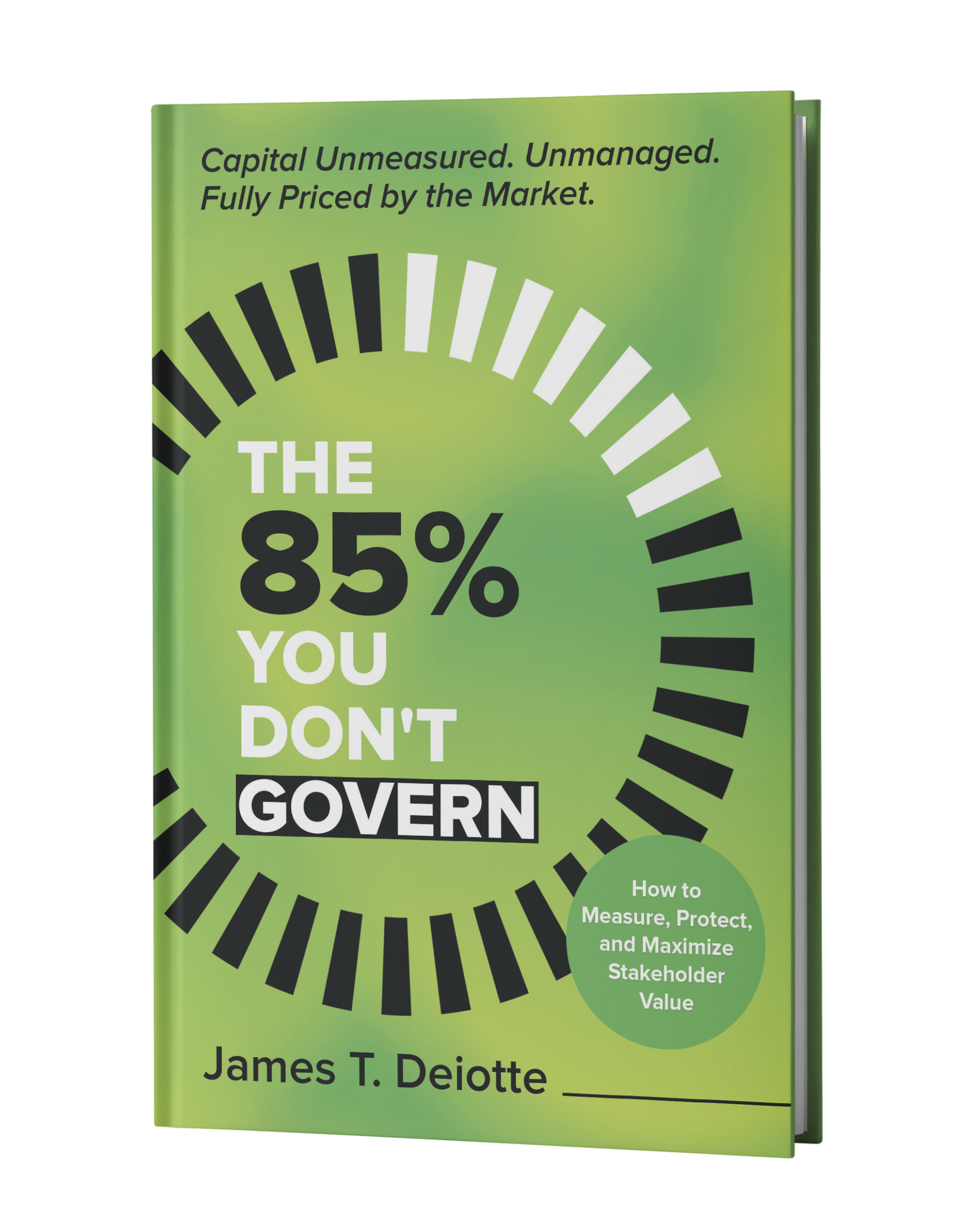
85% of your company's value is invisible to the system meant to govern it.
In 1975, tangible assets represented 83% of S&P 500 market value. Today, that ratio has completely inverted: 85% of value is now intangible — relationships, reputation, intellectual property, and stakeholder trust. Markets price these assets every day. Yet most governance systems still focus on the 15% they can see and touch.
More than 85% of enterprise value now lives in stakeholder capital: the relationships, trust, reputation, and capability that don’t appear on any balance sheet and can’t be owned. Markets already price it in. Your governance systems can’t see it.
So it erodes quietly, talent slips away, a regulator turns, a key customer drifts, until it impairs all at once, as a sudden charge. Positive stakeholder capital compounds enterprise value. Negative stakeholder capital silently destroys it. This book is the system to finally measure, protect, and grow it.
A continuous system, not a one-time audit.
01
Map and Measure
The Stakeholder Balance Sheet
02
Engage and Assess
The Engagement Cycle
03
Govern for Growth
The Five-Step Cycle and 90-Day Action Plan
The 85% you don't govern
James T. Deiotte · Published 2026 · Gatekeeper Press
The Unprotected Stakeholder Capital That Drives Your Valuation
Markets have always priced stakeholder capital. Leaders have never measured it. Drawing on four decades of international experience and the governance traditions of the IIRC framework and King IV, this book presents the complete system for governing the value that drives modern enterprises.
It is both a practical method and a new vocabulary, a way to see, name, and manage the relationships, trust, and capability that traditional accounting leaves invisible.
- 15 chapters, outlining from imperative to mandate
- The Six Capital Lenses and the full Engagement Cycle
- The Stakeholder Balance Sheet and valuation method
- Five steps from measurement to action
$$$ Hardcover · Kindle · Audiobook
A new operating system for the intangible economy.
In an era where 85% of enterprise value is intangible, traditional business frameworks fail. Financial statements capture only a fraction of what drives performance. Relationships, trust, culture, and reputation—the forces that actually determine success—remain invisible to the systems we use to manage organizations.
This book introduces the Stakeholder Operating System™: a rigorous, practical framework for measuring, managing, and growing the relational capital that drives enterprise value. It’s not theory. It’s an operating system built for leaders who know that what they can’t see is what will determine their future.
From the Preface
The market has moved. The governance hasn't.
From Chapter 1 · The Irony of Stakeholder Capital
The terms were always there. They were never examined.
From Chapter 11 · The Stakeholder Balance Sheet
The impairment was recorded only after the value had already been destroyed.
Put the system to work.
The Workbench is the operating system for the Five-Step Cycle. A guided, step-by-step platform that turns stakeholder relationships from implicit assumptions into explicit, measurable, governable assets.
Stakeholder Balance Sheet
Map relationships across all six capitals.
Covenant Framework
Make mutual dependencies explicit.
Six Capital Scoring
Quantify what was previously invisible.
Benchmarking Tools
Compare your profile against peers.
90-Day Action Plans
Turn measurement into governance.
Board-Ready Reports
From data to governance in one cycle.
Introducing the SOS Workbench
Stakeholder Balance Sheet
Map relationships across all six capitals
Covenant Framework
Make mutual dependencies explicit
Six Capital Scoring
Quantify what was previously invisible
Board-Ready Reports
From data to governance in one cycle
Included with the book
Your book unlocks the Workbench
Every copy of The 85% You Don’t Govern includes a complimentary access code for the SOS Workbench, free through December 31, 2026. Apply the Four-Point Method, map your six capitals, run the Five-Step Cycle, and generate board-ready governance reports. Read the book, then put the system to work.
No spam. One email when the Workbench is ready. See our privacy notice.

James T. Deiotte
Founder, JADE Advisors · Author, The 85% You Don't Govern
Jim is a global advisor, former Big Four senior partner, and educator whose career spans four decades across the United States, Europe, Africa, and Asia.
A Cleveland native, he spent more than two decades at Ernst & Young, ultimately serving as the firm’s Tax and Law Markets Leader for Sub-Saharan Africa, a practice spanning thirty countries. He advised multinational corporations on governance, risk, and compliance in complex operating environments, and served on EY’s Global and EMEIA Tax Executive Committees.
It was in South Africa, where integrated reporting became mandatory for listed companies, that the idea behind this book took shape. He watched organizations disclose the Six Capitals without governing them, naming their stakeholder capital while leaving it unmanaged. The Stakeholder Operating System closes that gap, turning the value leaders report into value they can actually measure, protect, and grow.
Today, Jim serves as Executive Director of the Master of Professional Accountancy (MPAc) program at UC San Diego’s Rady School of Management, where he teaches the next generation of business leaders to govern stakeholder capital with the same rigor applied to financial capital.
He holds a Juris Doctor and an MBA, and is a Certified Public Accountant (CPA), Certified Management Accountant (CMA), and Certified Information Privacy Professional (CIPP/US). He serves on the Cleveland State University Foundation Board.